

How Elasticity adds value
- How to design for elasticity
- Practicality: ♥ ♥ ♥ ♥ •
- Theoretical: ♥ ♥ ♥ ♥ •
What is Elasticity in F2P Game Design?
I’m in the fortunate position to be able to mentor a game studio within the Google Play Indie Games Accelerator program. During one of the meetings with the studio that I’m mentoring I’ve discussed what I’d like to call elasticity in F2P Game Design. I’m not sure if that term is used widely, or that I just call it that in that particular meeting, but it got me thinking deeper about the subject. This article will discuss exactly what I mean and why I think it is important for F2P game to have elasticity and how it provides value for the player, value that could be monetized.
In order to fully understand what kind of elasticity I mean, let’s take a look at how games afford progression.
Basic Game Progression
Basic game progression requires the player to complete the core loop in order to advance. In many games, a single core game mechanic such as matching puzzle pieces or a collection of core gameplay activities like fighting a battle are enclosed in levels. Completing one level will unlock the next level. New levels will introduce new mechanics, feature new artwork or spice things up in any other way. This type of progression does not feature any elasticity in the sense of this article, progression is binary, WIN to progress, FAIL and stand still.

Simple Meta
Many casual games introduced a meta-progression layer that required the player to complete a level to advance on the meta-game. Games such as Candy Crush, which created a deeper sense of progression by visualizing the player’s progression through levels represented as dots on a map.

These so-called Saga Maps allowed for some neat features, such as displaying the progression of your friends and hinting at new levels and themes up ahead, creating a nice feeling of anticipation for the things to come. They did however, not introduce elasticity in the outcome of the levels, as one level would still very much progress 1 step on the map.

Basic Progression and Independent Meta
Gardenscape popularized what I’d like to call the independent Meta-Game, that decoupled linear level progression from the meta-game progression. Player’s would still complete level after level in a linear fashion, the same way as they would in games with Basic Progression. But in addition, completing levels would also reward the player with 1 star-point. That star point would unlock 1 step in the Meta-game. After a certain number of steps into the Meta-game, the requirements to unlock the next step in the Meta-game would change to 2 stars and later in the game that requirement went up further and further.

Here, the progression of the Meta-game is flexible, displaying elasticity. The amount of levels that the player needs to complete is independent and detached from the progression of the meta.

Elastic Progression and Independent Meta
But now I’d like to talk about Elastic Progression. If we keep the Gardenscapes example in our heads, elastic progression would allow the outcome of a level to change from 1 star, to multiple stars as well. In fact, Gardenscapes introduced Hard levels that would give the player 2 stars.

However, only certain levels will reward either 0 (failing the level) or 2 stars (winning the level). True elasticity would come from a system that would always allow something to influence the outcome, every time.
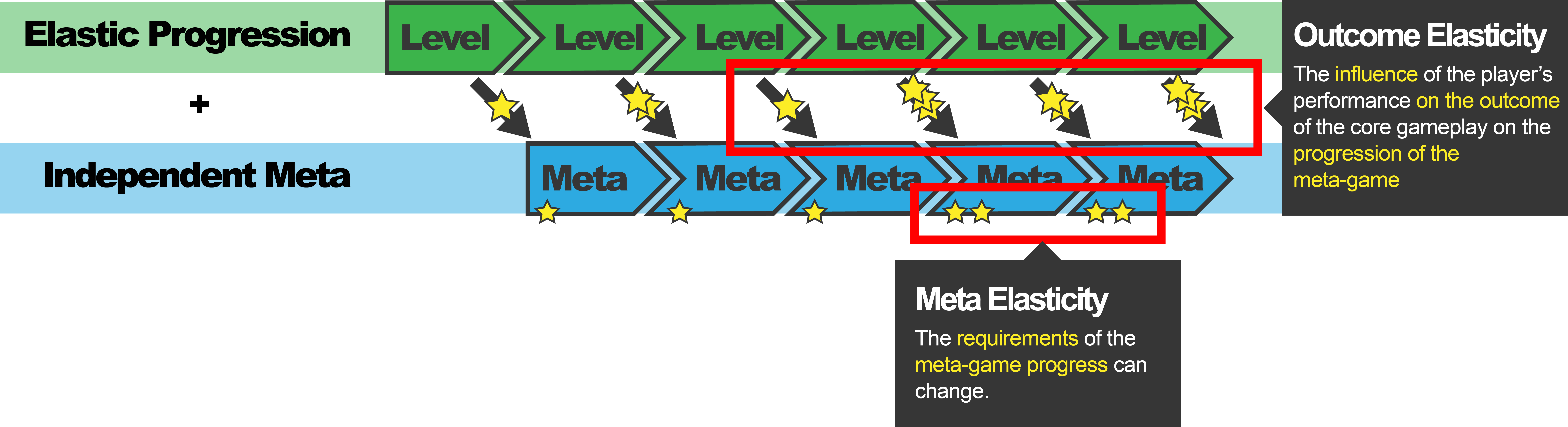
This type of elastic progression can be based on any number of things, such as:
- The performance of the player
Formula 1 provides a flexible amount of points based on the position that the driver finishes the race. Position 1 earns 25 points, position 2 earns 18 points, etc. In one of our own games, Heart’s Medicine, the outcome of a level was determined by how well and how efficiently a player helped her patients in a hospital. Patients that were treated fast and efficient would be worth more points and racking them up at the check-out counter would reward additional bonus points - The effort or investment of the player
In games where skill is less favorable to be used to create elasticity, effort such as endurance or investments in units could be used as a way to create elasticity. In our latest game we’re using elasticity that is created by upgrading the playing units. This still creates that exciting feeling when completing a level with much more score as a previous level.
So, why is elasticity important?
Elasticity provides positive emotional value
The biggest reason to add elasticity is it creates room to add value for the player, value that is felt directly where the player seeks value the most – progression.
Let’s take a hypothetical example of a meta game that requires stars to progress the meta-game. Each level will give the player the possibility to earn 5 stars, based on their skill as a player. If a player performs OK, she’ll receive 1 star, if she’s really good, she wins 3 stars and if she’s absolutely nailed it and plays the level perfectly, she’ll earn 5 stars.
Now, the meta-game requires 25 stars to progress to the next reward, such as upgrading your mansion’s living room carpet. In order for the player to reach that next stage in the progression and get to choose a different carpet, she needs to play level and depending on the outcome she could:
- Play 25 level with an OK performance
- Play 5 levels perfectly
- Or play between 5 and 25 levels if her performance is somewhat between these 2 extremes

A player that performs well is rewarded more, this feels as a fair system. The meta progression is valuable. Now consider that watching an ad will double any stars she earned during a level. This makes watching an ad equal in value to playing 1 level and depending on the player’s performance during that level the value increases. This added value can only be provided by decoupling level progression from meta-game progression. However, adding the elasticity to the outcome provides elasticity in the perceived value. Watching an ad can feel good in any of the player’s performance, consider the following scenarios:
- A player feels this level was particularly hard and is glad she finished it, although her score was 1 star. By watching an ad, she is still able to get 2 stars out of it
- A player had an easy time and was able to complete a level with 5 stars. She feels great about her performance and although she wouldn’t bother with ads in normal occasions, doubling her perfect score feels to good an opportunity to ignore
In any occasion watching ads is equal to the player’s performance and will change the pace of progression to:
- Play 25 level with an OK performance and no ads
- Play 13 level with an OK performance and watching ads
- Play 5 levels perfectly
- Play 3 levels perfectly and watch ads
- Or play between 5 and 25 levels if her performance is somewhat between these 2 extremes and watching ads or not, depending on the way she feels about the value provide by the ads at that time

I’m a big fan of rewarded video ads as I believe that voluntary ads provide a much better player experience and the game must do its very best to explain the value they offer the player in return for the ad-watch. There’s a big value in the possibility for the player to turn down an ad offer. If a player doesn’t feel the ad offer is valuable, turning it down has a positive effect on the player’s mood and will still increase the value of experience. But the value expressed in the elasticity in the example above doesn’t need to come from rewarded videos and can of course be monetized through in-app purchases or any other exchange.
Elasticity provide great variety and balancing options
If we continue with the imaginary example above and the meta-progression would take 5 stars to progress at first, players would feel they move fast through the game. But if meta-progression would take 100 stars to progress, the player would feel things were moving slowly and require them to play for very long to progress. The elasticity in the meta-progression can be used to create different effects.
Let’s say the next step if our progression is not to change a single carpet, but to paint all the walls in our house – which feels like a much more valuable progression step to the player – this would make it also feel obvious to increase the amount of stars it would require. This is elasticity where it can play with player expectations and perceived value. It allows the game designer to balance value to player expectations and increase or decrease the player’s progression pace. That is a powerful tool to have as a designer as it will control the pace of content consumption and ultimately how hard the team needs to work to create the next batch of content.

 Tj'ièn