

Rethinking the F2P Customer Journey
- How a player becomes a customer
- Practicality: ♥ ♥ ♥ ♥ •
- Theoretical: ♥ ♥ ♥ • •
Sometime ago I thought about the amazing journey a player undertakes to get to the point of making a purchase in a game. As a Free-to-Play (F2P) designer it is an additional part of our job to not only design the game experience, but also to make sure that a player will spend some money on it.
It started with a realization about the very first moment a user decides to click on an ad. Have you ever thought about that moment? It is a tremendous barrier for myself to click on an ad, like seriously.. I have been primed to avoid ads on the web since the 90’s. So it really amazes me how effective ad campaigns can be and it made me realize that I want to try to design the best possible experience IN the game AND also the journey towards it. This notion got me interested in the concept of customer journeys.
I think as F2P designers there’s a lot we can learn from more traditional fields of marketing and retail now that we’re also in charge of designing the shop inside the game.
When researching the customer journey I came across the following model and derivatives of this. I call this the “traditional customer journey” model.

This model takes the customer on a journey from becoming aware to deciding to purchase and after using the product and hopefully enjoying it even becoming an advocate of your product. And it is easy to see how this applies to games too. But for F2P games, this model isn’t accurate anymore, as installing the game could be considered an additional step in the F2P customer’s journey and within the game a similar process happens with in-app purchases (iAP’s) and in-app ad watches (iAA’s). To help structure my thought process around something more accurate I created the following F2P customer journey model.
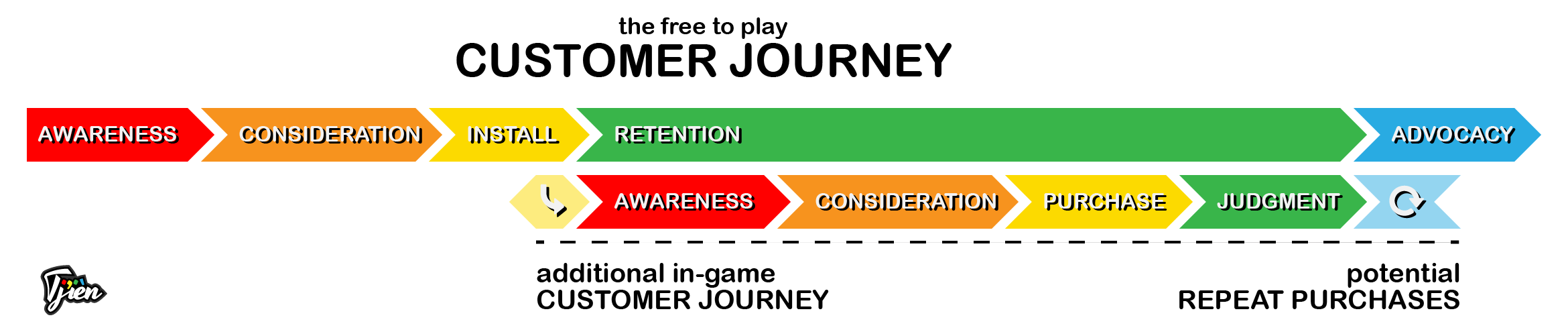
A F2P customer will actually start to walk on 2 paths simultaneously when they’ve started playing your game, making our job way more complex than traditional marketing as we’re not just trying to persuade players to play our game, but try to persuade them to make one or preferably multiple purchases within the game.
Looking at this journey from this perspective makes it immediately clear why retention has become the dominant KPI with F2P games, as the in-game customer journey can only exist when the game is retained.
So let’s break it down.
Awareness
Customers become aware of our games mostly through ads, but also more organically by searching through platform stores offerings (eg. Google Play Store) and if you’re lucky through features in these stores or through word-of-mouth (incentivized or not). The more well known your game becomes at this stage, the more likely your player will continue to the next step..
Consideration
The consideration stage is activated by crossing the first barrier to entry: engaging with the ad, or clicking the app icon in the stores. This action takes the player to your product page in the store where there’s an opportunity to display your game and add some details in the hopes to get your customers to install the game.
It amazes me how many customers abandon their journey at this point, especially considering the barrier to get here is huge. There’s so much potential in getting this step of the journey right it is mind boggling.
Install
Installing a F2P game can be considered the customer’s first purchase in a sense. They have decided to commit a few minutes to your game and decide if they’ll like the game and probably check it out again or dismiss it as a disappointing affair. I consider these first few minutes as part of the install phase.
Even though plenty of players will install a game only to have it sit on their home screen for ages. I was always puzzled by this behavior until I caught myself downloading games that I never played. Heck, I even buy PlayStation games that I still have to take out of their wrapping.
Retention
For as long as the game is valuable to the player, the player will come back to it. The more a player returns and the lengthier their play time is, the more time there is to convince players to become paying customers through their second journey.
Retention is so important in F2P games, mainly because the player will start on a second customer journey within your game that requires at least as much effort as convincing players to play your game.
iAP and iAA Awareness
While you are entertaining your customers through the game’s world, stories, game mechanics, audio and visuals you have to make sure the player is aware of the items that your game has for sale. Basically you not only have a shop, to which you put a sign out, you are also adding in-game ads promoting your shop OR ad positions inside the game experience to make sure players are aware.
It is OK to advertise in your own game, explaining that there’s a new deal or in fact that there is a shop available to the player.One of my favorite ways to create customer awareness about in-game shops is to add a nice freebie in the shop on a regular basis. Supercell’s Brawl Stars adds a randomized freebie in their shop daily and makes customers aware every day about all the other items that are for sale, while also providing something nice in return.

iAP and iAA Consideration
Consideration at this stage is all about the value of your item in the context of the game experience and how well the game has been able to convey that value. This happens in the game’s shop through nice images of the items, clear descriptions, and anchors that provide the in-shop comparison points.
But more important is to communicate the value of a particular item throughout the game experience. What the player will be able to do or experience with the purchase should already be clear before thinking about visiting the shop. One often used technique is to create a soft currency that allows the player some particular benefits when spending it on power-ups, boosters and what not. At some point, when the player runs out of this currency, the player is well aware of the benefits and might consider paying for it.
There are many ways a game can create value, but that is a topic on its own that I hope to address in another article at some point.
iAP and iAA Purchase
Once the player has made up their mind and decided the purchase seems worthwhile there’s still a hurdle to cross and do the actual purchase – although this part is largely handled by the device OS and out of our control – it is good to know how this works and what the player experiences.

Another part of the perceived value that can be directed through design happens right after the purchase is made. The award ceremony that happens after the purchase is validated has an immediate impact and can delight or disappoint players and determine the course of actions that follows.
iAP and iAA Judgment
When the player has received their items they will judge the value it offered and compare it to their expectations and experience they have with similar purchases. Will the game be more fun with the purchase? Does the fun last long enough considering the price I paid for it? Did I need the purchase to progress? It is critical that this judgement phase is experienced positively in order to make additional purchases more likely.
Advocacy
Bringing both player and customer journeys together is the player’s general sentiment about the game, carefully built up through days, weeks or months playing the game and potentially buying items.
Game advocates and ambassadors are the players that enjoyed your game so much that they’ll tell their friends about it or leave positive reviews for others to read. They’ll hop onto forums or comment on your blog posts. These players will bring in more players organically (for free) and increase your install base. This is becoming increasingly important as User Acquisition costs will continue to climb upwards.
The F2P Customer Journey
The F2P customer journey – consists of more steps and it’s interwoven experience and products make it more complex – than the traditional customer journey. However, because a large part of the F2P customer journey takes place inside the experience you fully control, it provides lots of opportunities to tweak, test and design each touchpoint carefully.

 Tj'ièn