

Where to find value for players
- Investigating IAP and Player Agency
- Practicality: ♥ ♥ ♥ ♥ •
- Theoretical: ♥ ♥ ♥ ♥ ♥
Our latest project – for which I can’t share too many details as of yet – is developed in an interesting way. We’re developing a couple of variations of gameplay and testing them back-to-back in a live environment (released in the US). This is interesting for several reasons and allows us to “test the waters” early on, and seeing if our predictions are correct. But from a design perspective, it allows me to thoroughly think about the implications of seemingly slight variations in gameplay.
We started development of 3 variations of ganeplay. One variation which is more free-flowing and action oriented and 2 variations that acted more like puzzles. The theme and presentation of each of the variations was equal. Not all variation felt equal, as the third variation felt more complete than the other.
We decided that we wanted to continue 2 variations, the action variation and the more complete puzzly variation. While designing the action variation for a couple of weeks I turned my thoughts towards the puzzly variation and I noticed something strange. The puzzly variation didn’t allow for much – if any – great and valuable purchases for the player. Which made me think of the player agency afforded by games and puzzles, which I investigated in a previous article.
For IAP (In App Purchases) to be valuable to the player, the player needs to be able to influence the game in some way. A certain player agency needs to be available if IAP are to be of value to the player.
Puzzles, by their very nature, allow for limited player expression. The player needs to find the solution. Sudoku is a great example, the player needs to fill the grid with numbers in a particular order. There is not a lot of strategies or player expression possible. This lack of agency creates a lack of valuable purchases that can be offered. Hints are the only valuable thing to offer to a Sudoku player.
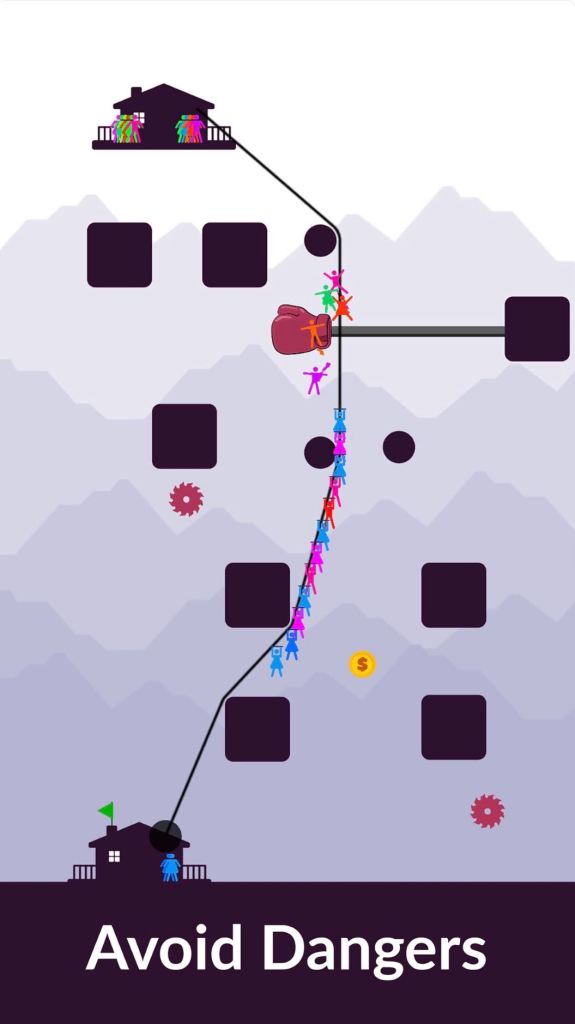
For this reason I decided to try a few free puzzle games and see if and what IAP they offered to the player. The first 2 at the top of the charts displayed an extraordinary amount of ads and the only purchase they offered was the ability to remove these. Other popular puzzle games – like Sandwich – seem to follow the same trend by being supported by ads and only a single -remove ad- purchase.
A Game Analytics report also seems to suggest that puzzle games are mostly supported by ads with low ARPDAU (Average Revenue Per Daily Active Player) and ARPPU (Average Revenue Per Paying User) values. Similarly, other games with low player agency, like trivia and word games seem to follow the same trend.
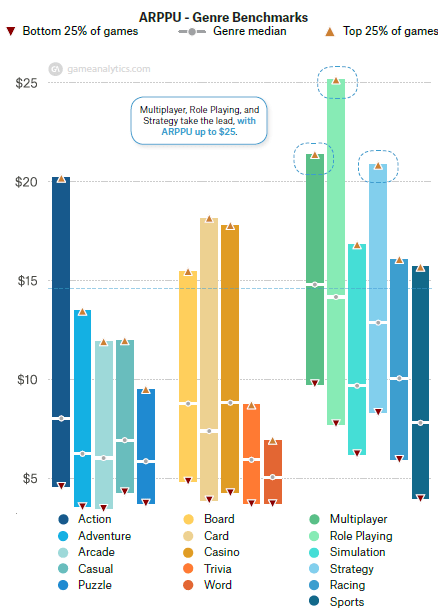
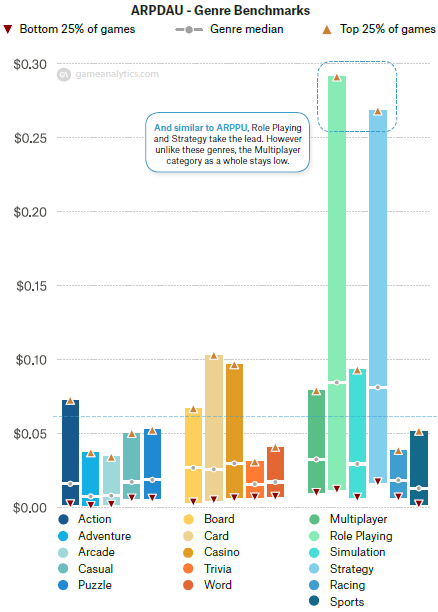
This seems to suggest that – in order to add valuable purchases for players – puzzles and other low player agency genres need to add player agency.
 Tj'ièn